


1.9.16
Being Responsible. Your Turn.
Two Ola Cab Drivers have raped and murdered a twelve year old child in Kolkata. The girl was forced into the taxi by Shankar Shaw and Guddu Singh, where they took turns to rape her, following which they strangled her and threw her off the bridge. The child’s body was found in the canal.
Both the drivers were reported to be drunk and have said that they were out to have fun.
Both have been arrested.
Both have been arrested.
Sickened, shocked, horrified.
This isn’t a first.
"We are saddened by the reports of the alleged misbehaviour of a driver in Kolkata. On preliminary identification of the cab details shared by authorities, we have suspended the account associated with this cab with immediate effect. As per our records, this incident has not occurred while on the Ola platform. We will work with the authorities to share any information that will help support their investigation."
To All Taxi Companies,
To Whom It May Concern
To Ola
- What measures are you taking to ensure safety of all women , girls, children, individuals? To place an emergency button is to say , “ we did our job”, and frankly that’s doing nothing, or help us understand what it is doing/ has done so far.
- Do you invest in training ? If yes, we would like to know more.
- Employ and invest in women drivers, ‘Action Hero Drivers’, not in pink taxis, not for women by women, but for all. Envision. Initiate. Empower.
- Own up to a lack of focus and responsibility in this territory beyond calling incidents of violence, rape and murder, as ‘saddening’ , and or ‘unfortunate’. This isn’t about one incident or three. This is about an attitudinal shift, systemic change. This is a long path. Commit to a collective vision for a safe and inclusive world. You have the potential to make immense contribution, if you can see it too.
- If business language is most easily heard, here goes: you lose out on women customers if they don’t trust your service.
Blank Noise Team
I Never Ask For It Writing Programme : Apply To Intern
We are offering an internship starting September 7th, 2016 towards the I Never Ask For Ittext series. Do apply and share this call in your networks too!
We seek Action Hero individuals who :
i) Are thorough on the discourse on sexual and gender based violence. Have a keen interest in tackling victim blame
ii) For whom word is medium. We are open to applications from a range of writing practices and form ( poetry, report, essay + )
iii) Those who identify, connect and feel passionate about Blank Noise's approach towards addressing sexual and gender based violence.
iv) In addition, we also seek individuals who can do outreach and community enabling work with university students.
The intern towards this programme could be located anywhere. The programme editor is based in Delhi- applications from Delhi and nearby are further encouraged, however, not the criteria.
Apply here : internship
Deadline: Sept 3rd, 2016
29.8.16
Clothing and its Discontents
(Hi, I am Atreyee, a Blank Noise member for over a decade and a loyal associate of General Patheja. Other than watching the expansion of Blank Noise with great joy, I have long debates with Jasmeen on all things related to gender and its socio-political implications. I tweet at @milagrenia. Thanks!)
I watched the Qandeel Baloch murder on the internet – first
in anger, then in confusion, then in surprise. A young girl’s heinous death at
the hands of her brother turned into an internet festival, not dissimilar from
the Nirbhaya rape of December 16, 2012 in Munirka, Delhi. The feminine personalities
at hand are entirely different. Nirbhaya was trying to get an education and eke
out a living as a medical professional in Delhi. She carried the respectable
expectations of her middle-class family. Except one day she took a bus at
night. Qandeel craved fame and power. Un-respectable things for women to crave,
even strive for. She took to the internet and an active use of her sexuality in
order to generate fame and finagle a ticket to the world of celebrity. This was
not alright for someone of her socio-economic strata to do, someone who had
been married young and was the mother of a child. It is women like her that are
supposed to become beneficiaries of upliftment programs, companies’ affirmative
action programs, NGO-fodder for ‘violence against women’. Always the passive
recipient of care – one whose destiny is determined by others. Qandeel rejected
that image. In ways that struck many custodians of societal morality as ‘vulgar’.
What kind of a feminist was Qandeel? My friend Sarover wrote on Facebook,
“the relationship between feminism and sexuality
is a complicated one.
if complicit to patriarchy it is oppressive,& sometimes if explicit, still continues to be complicit to patriarchy.even when we choose the liberator discourse we land up in the other jail set up for feminine, namely the exploitative gaze.i wonder if there is a way out. the same conditions do not hold for men. liberation does not depend on displaying the libido or hiding it. male space as much more an agnostic space of being, body and becoming. but our history is tainted with honor killings, mutilation, abuse and extreme conditions of oppression and exploitation. so the testament continues, the near irrational imbalance of liberatory celebratory sexuality as commodity, on one hand and the vile, vicious and violence of the everyday forms of patriarchy on the other.”
if complicit to patriarchy it is oppressive,& sometimes if explicit, still continues to be complicit to patriarchy.even when we choose the liberator discourse we land up in the other jail set up for feminine, namely the exploitative gaze.i wonder if there is a way out. the same conditions do not hold for men. liberation does not depend on displaying the libido or hiding it. male space as much more an agnostic space of being, body and becoming. but our history is tainted with honor killings, mutilation, abuse and extreme conditions of oppression and exploitation. so the testament continues, the near irrational imbalance of liberatory celebratory sexuality as commodity, on one hand and the vile, vicious and violence of the everyday forms of patriarchy on the other.”
Sarover is right, in a way. And she is definitely a
fire-breathing feminist. Let us examine Sarover’s argument quite carefully –
she is saying, that the ability or intention to display libido should not be
considered a measure of feminism. It is not. I agree with Sarover, especially
in her critique of the western triumphalist in challenging and showing as
un-modern, the social fabric of the Other. My only addendum there would be that
women’s bodies are necessarily interpreted through the rubric of male desire
and male anxiety about male desire. It has been said in feminist discourse,
enough times, that female bodies are constructed as passive, devoid of the
capacity to desire. But the furore over women’s definite acts of showing or
hiding libido causes tremendous anxiety within all kinds of patriarchal
structures as it shows women becoming live, definitive subjects. So I am not
going to participate in the argument over which women is feminist and to what
extent. The argument has already gone around showing that women who observe karvachauth, or give up their jobs for
domesticity can also be ‘feminist’. My emphasis is on showing how paranoia
ensues when women emerge as subjects,
push back against a force, show the existence of an inner will, talk or observe
silence to make their point of view known, embrace publicness where privacy is
expected, embrace privacy when publicness is expected. Societies, of varying
grades of patriarchy, allocate varied roles for different groups of women –
thus, the wife and the slut are co-produced with different sexual and social
functions satisfying diverse needs of men.
Qandeel disturbed this arrangement – at least in the
perspective of her brother. The thousands of men who googled her and voyeurised
on her internet-presence saw her role differently though, but narrated their
disapproval according to societal expectation. Nirbhaya did something that
disturbed her perceived role as a young woman in the city of Delhi. Took a bus
in the evening. I disagree with much of the conversation around gender justice
that takes a particular object of clothing and a particular act of movement and
frames it in judgment of the quantum of violence or restraint attached to it by
patriarchy. My point is that the patriarchal disavowal cannot be seen in a
single object or act alone - it must be
seen in accordance with what perceived set of expectations for that particular
woman (in her socio-economic location) are. For instance, on Indian roads and
public spaces, the same clothes that pass the threshold of judgment on
non-Indian-looking (often meaning mainland India, excluding the north-east)
women, will not pass the threshold for Indian, or ‘local’ women. In this
hypothetical example, different sets of expectation are being pinned on
different women based on their ethnic, racial and cultural origin as understood
by those casting the male gaze.
In this context, we come to the latest incident of the
police forcing a woman to strip from her burkini on the beach of Nice, France.
The burkini being similar to the wetsuit is not the talking point here. For it
is not the wetsuit. It is a garment
women, given their communitarian circumstances, have chosen to wear in order to
the enjoy the pleasure of water-sport in keeping with the religiously coded modesty
regulations that are cast on their bodies. The burkini, therefore, becomes a
site of two patriarchies battling it out. One saying you’re weird and you
should not be seen among our midst. The other saying if you show your skin to
other men, you disrupt my claim to honor since you’re my wife, mother, daughter
– my kin-territory. Strangely, I think, the police’s abhorrence of the burkini
have not as much to do with the perceived submissive role played by Muslim
women, but to do with their disruption of the culturally coded aesthetic of the
‘beach’. A site of peculiar westernized mode of pleasure and sexual expression.
The same women could have worn their Muslim dress and stood behind a counter in
a shopping mall, it would perhaps be okay. But they dared to come out on the
beach in Nice. Where the west is enacting its westest self. It’s like if a
woman wore a bikini to a Hindu temple. It’s a spatial disruption that this
woman’s garment had inadvertently caused.
When we incessantly compare western women and non-western
women’s practices and cultural codes, especially in the garb of intersectional
feminism, we forget that in the grid of culture and gender there is a
complicated, systematic division of images, perceptions, expectations allocated
on the bodies and minds of different women. Some women are expected to lend
their bodies for male aggrandizement, if they turn celibate – there will be
much consternation. Other women are supposed to be submissive wives and use
their sexuality entirely towards reproduction of the family and the clan. Their
alteration of roles and images, as we have seen, in the Baloch case, causes
violent reactions. We must, in assessing these cases, see all the women as
serving diverse needs of the patriarchal machine, and their purposeful or
inadvertent subversive acts causing much perplexion which at times culminates
in brutality. We must also remember that a larger political and masculine
battle among several imperial actors is being carried out for sovereignty over
land, culture, resource and discourse. The violence on women’s bodies, is
necessarily, woven into that larger battleground.
26.8.16
Paternity Leave - Letter To Maneka Gandhi
The Rajya Sabha passed The Maternity Benefit amendment, which now provides 26 weeks of maternity leave instead of 12 weeks, enabling and supporting new mothers to be with their new born. In response to questions on paternity leave, Maneka Gandhi said that new fathers wouldn't do much, and that it would be a holiday for them. link
Dear Maneka Gandhi,
Thank you for amending and extending Maternity Benefit from 12 to 26 weeks. I am certain that this is welcome by many across the country. This letter is an invitation for you to imagine an India that enables paternity leave too.
Yes, some men might use paternity leave as a holiday. The chances are high. This simply hasn’t happened before. Just because we have paternity leave doesn’t mean that men will immediately know how to co parent in the domestic space. or be emotional nurturers. We raise our boys to be ‘men’, embodying a kind of masculinity that often swings between numbness and rage, along with an idea of protection that polices their sisters, mothers, daughters, wives, where they protect ‘their women’ from other men. Besides ‘other men’, sexual / gender based violence within the family goes untold , unreported, not forgotten.
Men, mobs, fists, rage, stones, war, weapon, rape. Our bodies. What will they know what to do with a child? They will take a holiday.
Too many generations of men and women have been raised by distant fathers , sometimes financial providers, many who beat and abuse their mothers. (There is of course little record of marital rape, which is likely to lead to another open letter to you) Their fathers and their fathers fathers were not allowed to become their potential parent.
I write this and I am reminded that somewhere there are nurturing, and emotionally available fathers, but those are far and few.
I am still talking about paternity leave.
Everything has the potential of misuse.
Everything has the potential to set something right.
I write because I believe that one day when I do have a child, I will be a parent, a co parent that is responsible for the child’s well being. It would be a shared responsibility and I won’t settle for less. The state must allow it too. By enabling paternity leave, you will be recognising, highlighting, emphasising, enforcing, prioritising, drawing attention to the role of both parents in child care , mother and father. The act is not just meeting a need but also establishing a vision, a future for this country, where a child has been emotionally nurtured by both or all parents, and where you create space for men to become nurturers. They haven’t known it because they haven’t imagined it, nor encountered a role model, nor had the space. To establish a space is the first step. To learn to act in the space comes soon after. Yes , I am certain that it will be misused but it will also set the tone and vision which is needed: that which enables mothers to imagine parenting as a shared responsibility, and therefore enables women to unapologetically dream multiple identities , beyond motherhood should anyone wish to….
We are affected by one another and the choices we are allowed to make.
As someone who has witnessed and known different family structures , from single parent, two parents of the same sex, male parent adoption or surrogacy, hetero-normative “ hum do, hamaray do “ parents, I believe in the idea of parenthood over ‘mother’ or ‘father’ , because that too is a gendered construct. However for the sake of the conversation on paternity leave, I am stepping back and into the first conversation of the mother and father. We need both maternity and paternity leave. This is about domestic labour, our idea of motherhood and fatherhood and co parenting. This is also about how the state constructs masculinities, womanhood, motherhood, and allowing it new forms and expression.
I dream of a world of shared responsibilities regardless of gender. A world where women are not denied a job over a man, because they will one day be a pregnant ‘burden’ to the workplace. A world where the domestic space or home will also be recognised as a site of labour and love, instead of what it is right now. We have heard it before, “ I am ‘just’ a housewife ”, “ I don’t do anything, my time goes with my kids” . Motherhood is work. Home is work. It has been unpaid, invisible, undervalued work. Paternal leave has the scope to change the way we function both inside and outside the home, from ‘office’ workspace to the family kitchen (also a workspace). I also dream of a world where men are emotionally connected, invested and not on the verge of exploding with rage. I dream of a world where we are connected, truly connected, inside ourselves and amongst ourselves. Where we are present. Where the absent father is present. Being present in his child’s life could further create space for him to be emotionally connected with himself. That is a step towards ending violence against women and children.
We know change takes time. We know there will be misuse. We want you to envision, even if your job asks you to fire fight. Step back and imagine.
On behalf of many.
Action Hero
15.8.16

Akeli Awara Azaad : Freedom From Fear
 |
The Right To Live, Walk, Speak, Unwarned. No Excuse For Sexual or Gender Based Violence. I Never Ask For It.
100 Action Heroes across X places will walk #AkeliAwaaraAzaad in their cities, towns, villages, countries on September 25th. Sign up between August 15th- September 10, 2016 : email in actionhero@blanknoise.org
All Action Heroes will be connected to their city co ordinators, and sport a Akeli, Awaara Azaad T shirt ( also in four other languages). Akeli Awaara Azaad means, to be alone, an unattached wanderer and free.
To be alone, to be wandering, to be free asserts our right to live unwarned , especially on Independence Day. We ask for freedom from fear. To live in environment of warnings , is to be told, “ if you experienced violence , perhaps
you were not being careful enough” . Warnings lead to blame. Blame leads to shame and silence.Silence perpetuates sexual violence.
To participate , partner, associate or volunteer towards organising #AkeliAwaaraAzaad , connect at actionhero@blanknoise.org
Happy Independence Day To All Action Heroes from the Blank Noise Team! |
6.8.16

“I will not let Mahmood Farooqui’s act rob me of my idea of who I am,”
I have remained silent for over a year about the sexual assault/rape of an American Fulbright researcher by the founder-storyteller of the art form Dastangoi and the Peepli Live co-director Mahmood Farooqui.
But now that the fast track court trial is over, I want to speak about what I have known during this period.
First off, I would like to say that I know both the man convicted of rape by the court and the woman-victim of the rape.
I have known Mahmood Farooqui for about 5-6 years now. I was a huge admirer of his Dastangoi work. I had asked him to write an essay about this theatrical story-telling artform as intangible cultural heritage for a museum journal I was guest-editing. He is an intellectually sharp man and a creative powerhouse. After that, I began going to his home for the monthly story-telling practise sessions called baithaks. And met other members of his family and the Dastangoi team. Over the past 9 years, I have followed the Dastangoi stage performances keenly.
I am also a friend of the rape survivor, the American citizen. She and I met for the first time to have a conversation about museums – this was a few months before the incident occurred. And then after that, we became friends and met some more times. She has been coming to India for many years and is an Indophile and is an expert in languages and scriptures.
Two days after the incident occurred, the survivor messaged me and asked to meet. I was in my office. I did not know what it was about. She came over and she narrated the entire incident for two hours – in tears, anger, shock and loathing. She had been friends with Mahmood Farooqui and his wife. She had met Mahmood Farooqui for help with her research work in Gorakhpur (Mahmood Farooqui hails from that place).
She met me that day not because I am a journalist. But as a woman-friend. In her narration to me, there was a lot of shock and disbelief over what he had done to her. She wrote an email to him telling him what he did to her was wrong, and that he should know he cannot go through life doing this to other women. He replied to her email with a short apology.
But her anger and trauma did not end there. It wasn’t just an apology she was seeking.
She went back to the U.S. to be among her people, friends, family and her university system. She complained to the university. She sought legal advice. She tried to heal. She tried to process the incident mentally when she was home. Then she looked at her little niece and said to herself – “I always teach her to stand up and fight if someone harmed her. Would I ever be able to tell her that again if I remain silent now?”
Mahmood Farooqui is socially and intellectually influential. He enacts stage performances about injustice, human rights and gender. He is a Rhodes scholar. How can such a learned man ever do this, many asked.
Others said: She knew him, they were close friends. How can it be rape?
As if education and familiarity negates the act of rape automatically.
Even if I have known a man for long, a sexual act without my consent is rape. It has nothing to do with his education or his progressive support for the right causes. It has everything to do with the fundamental inability to hear and understand the meaning of the word “No.”
She said to me: “I have always been the person who owns her body and sexuality. What happened to me that night took that ownership away.”
She returned after a couple of months to India and filed an FIR.
Questions were asked about why she delayed filing the FIR. It is not always easy when you have known and trusted the perpetrator. It is easier to rush to the police station when it is a cab driver, or bus driver or stranger lurking in the shadows of the street. But when you know the assaulter – you go through several stages of coming to terms with it – shock, hurt, anger, loathing, self-questioning, shattered trust and so on.
She was also afraid of the rampant victim-shaming that goes on in India in rape cases. She wondered aloud that day if she would be able to survive the “blame-the-victim” mind-set that is so prevalent here.
And she did face that a lot during the pre-trial stage and in court. During the trial, her family in the U.S. and other places were inconsolable. She told her mother not to come to India because she did not want to expose her mother to the barbs and hostility she faced from Mahmood Farooqui's family and friends in court. She went through the court trial alone.
Overnight, a number of Mahmood Farooqui’s friends shunned her. In that circle, it was a virtual warzone and the lines were drawn over whose side you were on. The male friends and supporters of Mahmood spoke of a certain “bro-code” that needed to be upheld.
They even called her friends and asked them to “mediate” and drop the case. When we read in the newspapers how village elders and Khap elders attempt to "mediate" in rape cases, we get so angry and call them backward. But when we do it in the cities for our friends, it is part of a "bro-code."
The survivor did not think about the outcome of the trial. She is not out to get revenge or send him to jail for x number of years. Her impulse behind filing the FIR was simple – she had to act. Silence was not a choice. She wanted to believe in the law and the system. And by that mere act of believing in the system, she moved the battle forward – not just for so many other women like us but for her own path to internal recovery. She reclaimed some of her own sense of who she was.
“I will not let Mahmood Farooqui’s act rob me of my idea of who I am,” she said to me.
In this, there is a lesson for all of us. We are too familiar with the way the system works. We complain about police investigations, court trials, victim blaming and so on. But only if we keep pushing the system – and acting as if we believe that the process of justice is 100 per cent perfect – will the system eventually work.
She did not have the luxury of silence. And we do not have the luxury of cynicism.
First posted on Facebook by Rama Lakshmi
17.7.16
Say It Like An Action Hero
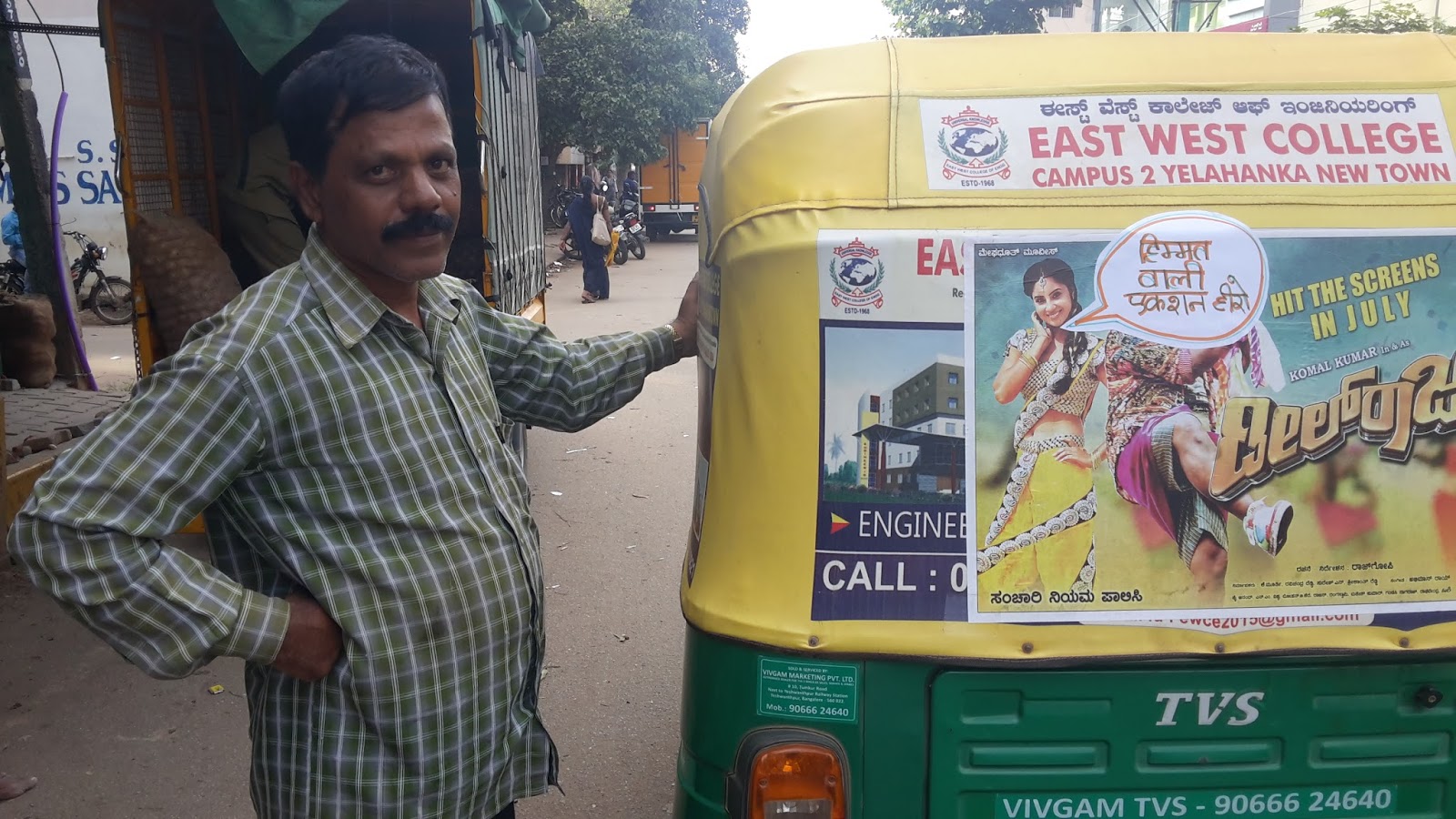 |
| Bangalore Auto Rickshaw Action Hero Driver |
Himmat Waali, Action Hero
Courageous one, Action Hero
|
Action Hero Hacker Tool Kit :
We ask our Action Heroes to be equipped with sticker paper ( easily available at all stationery shops), scissors and a marker.
Imagine every visual speaking reminding, repeating, reiterating in various ways , tones, languages.
"Freedom without fear. The Right to be unwarned. I Never ‘Ask For It'"
What affirmative words would you like to place over found pop culture visuals?
What would you rather every body said, instead of what they do say , you see?
Walk . Find. Stop. Write. Cut. Stick. Photograph. Send. Tweet.
Criteria and guidelines:
- Affirmative
- Affirmative
- Affirmative
- Build Action Hero Solidarity
- Affirmative
- Remember, this didn’t occur if you didn’t document it- don’t forget to take a photo and send it to blurtblanknoise@gmail.com
- Document
- Send. It did not happen unless you send it and we post it here :)
Subscribe to:
Posts (Atom)